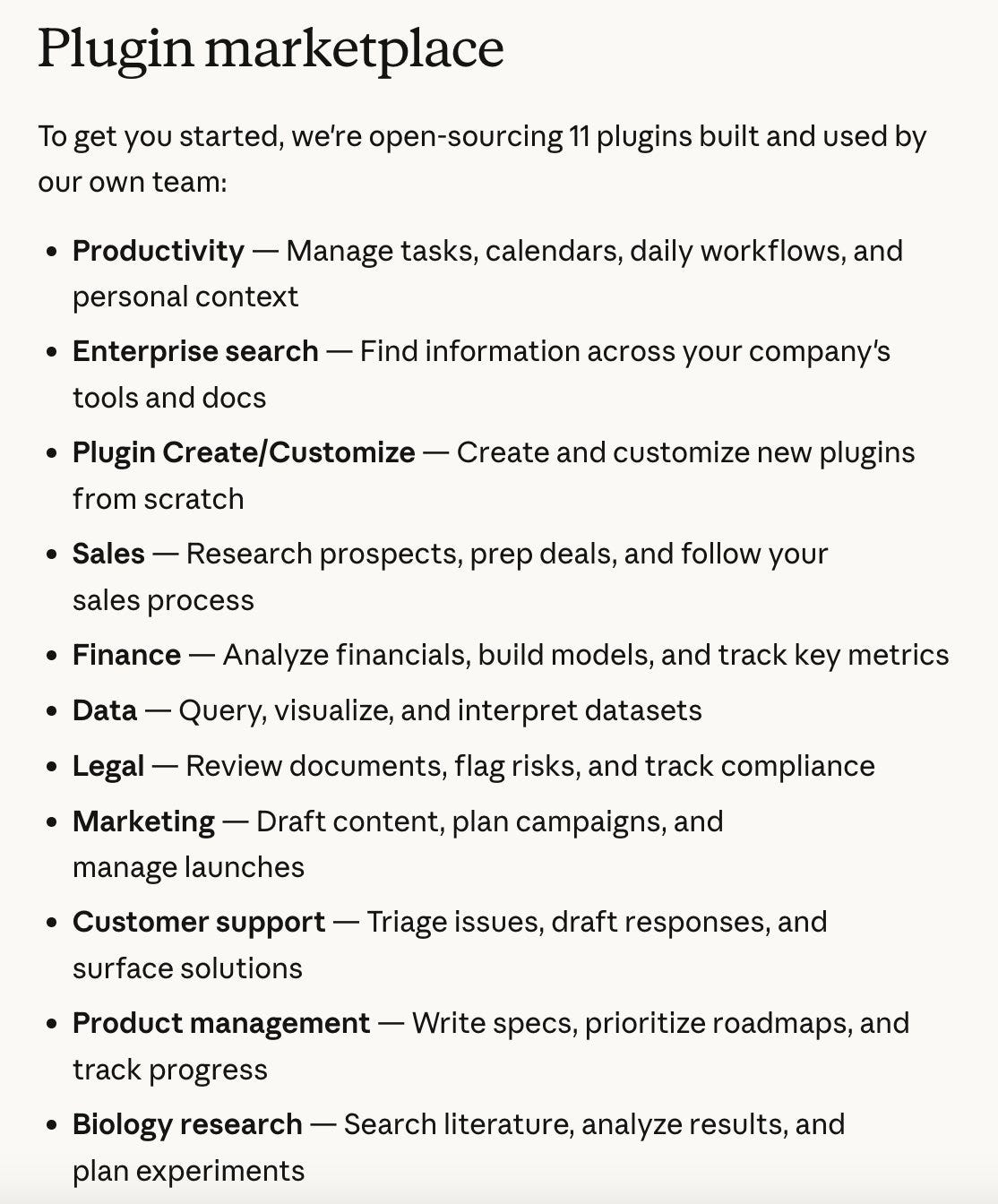
Anthropic’s announcement about launching Claude agentic plugins was kind of an eye-opener for me.
Before you mistake me for an AI expert, let me make this clear. I am not.
I run a business. I experiment a lot. I try to automate anything that feels repetitive or expensive. With my limited coding skills, I’ve picked up this habit of playing around with generative and agentic AI tools. They’re mostly fun to work with, especially when you have a clear business requirement. Sometimes it works. Sometimes it doesn’t.
My business workflow has a lot of routine tasks — capturing forms from websites, populating them into databases, sending responses based on enquiries, customer onboarding, CRM management, and so on. So I keep trying to automate work that can reduce the effort of a team member, or help them do the same task with less friction.
A lot of my inspiration for AI automation actually comes from the SaaS applications I already use for my workflow. I’ve been a long-time Zoho user, and the flagship product in my usage is Zoho Campaigns. It is kind of my key revenue driver. It captures leads from my landing pages, pushes them into specific lists, and sends bulk marketing emails at predefined schedules. I probably owe close to 80% of my revenue to this single app.
At the same time, I’m not very fond of Zoho Campaigns from a user’s perspective.
I am digressing.
When I started reading about agentic plugins — AI systems that can think, plan, call tools, and act on their own — my first instinct was obvious: can I replace this? If an AI agent can write content, segment users, schedule tasks, and call APIs, then a bulk mailer should be an easy win. In fact, I was convinced I could design something much better than Zoho for my exact use case. Leaner. Cheaper. More tailored.
And technically, I wasn’t wrong.
What I can definitely do better than Zoho
(and I think I’m 100% right about this part)
Zoho Campaigns is built for everyone:
-
ecommerce brands
-
SaaS companies
-
bloggers
-
NGOs
-
event marketers
It has to serve all of them reasonably well.
My use case is much narrower.
I:
-
send daily mails
-
follow a known structure
-
have a limited and predictable list growth pattern
-
send at almost fixed times
-
care about very specific analytics, not everything
Because of this, a custom app can do a better job for me.
A custom setup can:
-
auto-generate content directly from my CMS
-
auto-segment users based on my business logic
-
skip features I never touch
-
reduce ten clicks into one cron job
On workflow design, automation, and logic — winner: me.
Deep integration with my data
Zoho always sits outside my system.
My own app doesn’t have to.
It can:
-
pull stories directly from my database
-
personalise content based on real user behaviour (not just “opened last email”)
-
tag users based on actual actions — paid, inactive, industry, interest
-
send different content without creating ten different lists
Zoho’s segmentation is powerful, no doubt.
But it’s generic.
For my business — winner: me.
Cost control at scale
There’s also the cost angle.
If my list grows:
-
Zoho’s cost grows linearly (or worse)
-
my infrastructure cost grows marginally
At some point, self-hosting clearly becomes cheaper.
From a pure economics point of view, long term — winner: me.
Now… here’s the part I can’t casually beat
This is where Zoho actually earns its money.
The real moat: email deliverability
This is the big one.
And this is something you don’t see on a dashboard.
Zoho gives you, silently:
-
IP reputation warmed over years
-
shared and dedicated IP pools
-
relationships with ISPs (Gmail, Outlook, Yahoo)
-
automatic throttling when ISPs get cranky
-
bounce classification (soft, hard, spam traps)
-
feedback loop handling
-
complaint rate monitoring
-
sending pattern optimisation
If Gmail decides:
“Hmm… this sender looks suspicious today”
Zoho:
-
slows you down
-
reroutes traffic
-
protects your domain reputation
If you mess this up once:
-
your domain gets flagged
-
emails start landing in spam
-
recovery takes months
On deliverability — winner: Zoho (by a mile).
AI replaces thinking. It doesn’t absorb responsibility.
Compliance and legal insulation
Then comes the boring but dangerous part.
Zoho handles:
-
unsubscribe enforcement
-
CAN-SPAM requirements
-
GDPR edge cases
-
audit logs
-
proof of consent
You can build all of this.
But one small bug here equals a legal headache.
Zoho is basically your compliance insurance.
Winner: Zoho.
Infrastructure you don’t want to debug at 2 AM
There’s also a whole layer you don’t think about until something breaks.
Zoho has already solved:
-
retry queues
-
partial failures
-
ISP-specific errors
-
rate limits per domain
-
delivery timing optimisation
-
sending 100k emails without choking
If you roll your own, you’ll end up reinventing:
-
message queues
-
worker pools
-
bounce parsers
-
log processors
None of this adds business value.
All of this can break your business.
Again — winner: Zoho.
The honest truth
If the question is:
“Can I build something better for my use case?”
Yes. Absolutely.
If the question is:
“Can I replace Zoho entirely?”
Not smart — unless I want to become an email infrastructure company.
I don’t.
The hybrid approach that actually makes sense
This is where my thinking finally landed.
I’ll build my own campaign brain — content, logic, segmentation, automation.
And I’ll let Zoho handle the dirty plumbing — sending, deliverability, compliance, reputation.
In short:
Zoho as the safety net. My app as the intelligence layer.
That gives me control without anxiety, speed without risk, and zero legal surprises.
What really made it click for me was this:
Zoho isn’t competing with my ideas.
Zoho is competing with Gmail spam filters, Outlook abuse teams, global ISP policies, lawyers, regulators, and bad actors.
That’s not a fight I want to enter 😄
This post isn’t a prediction. It’s just a takeaway from trying — and abandoning — a bulk mailer build. I’m still exploring AI. Still experimenting. But one thing is clear now:
AI is the brain. SaaS is the nervous system.